
Most chairs invite you to disappear. You sit, you lean back, you soften, and slowly your body gives up its shape.
Your pelvis rolls under. Your low back flattens. Your shoulders drift forward.
By the end of the day, you are no longer upright. You are folded into the furniture.
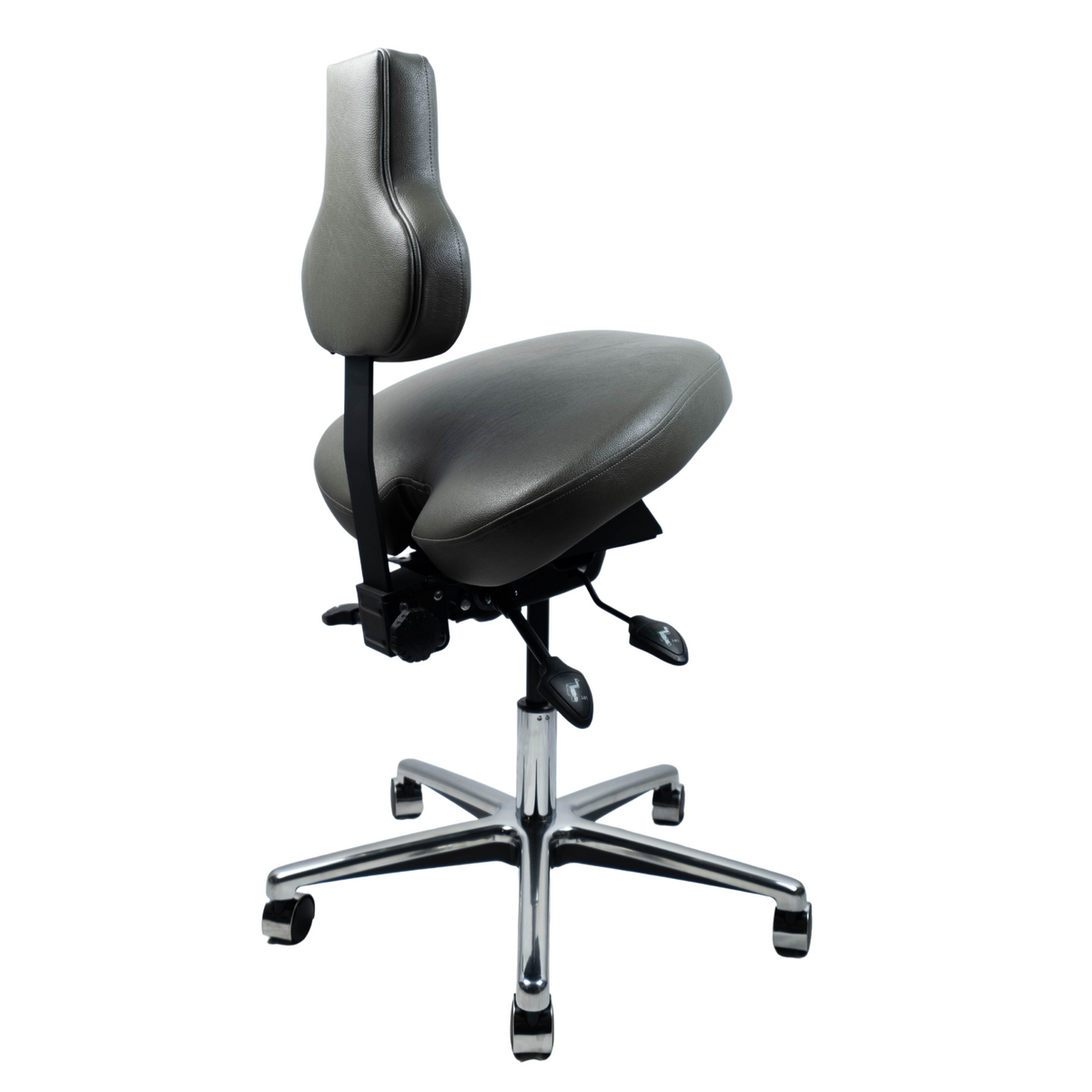
The NuChair interrupts that quiet slide. It does not try to rescue a collapsing spine with a thicker lumbar pad.
The adjustable seat angles forward. The front support subtly engages you. Your hips tip into a more neutral position and, almost automatically, the lumbar curve returns.
The spine stacks. You feel taller without straining. It removes the option to slump comfortably.
After the first three days of using it, I found myself feeling taller when I was standing in line to order at my favorite coffee shop.
As a chiropractor, that distinction matters. The pelvis is the base of the structure. When it tucks under, everything above it compensates.
I see it every day… Rounded shoulders. Forward head posture. Chronic tension that people blame on stress or screens or age.
Most chairs quietly accommodate that pattern. This one challenges it.
The first time patients sit in it in my office, there’s a pause. They look down at the angled seat. They shift. Then they say something like, “This is different.”
A few seconds later comes the surprise. “Wow. This is actually really comfortable.”
They settle into it, test the angle again, then sit a little taller without realizing they just adjusted themselves.
On the very first day of using it in my office, conversations started to drift. We’d begin talking about their neck or headaches and suddenly we are deep into a discussion about the chair.
Novelty opens the door. Experience seals it.
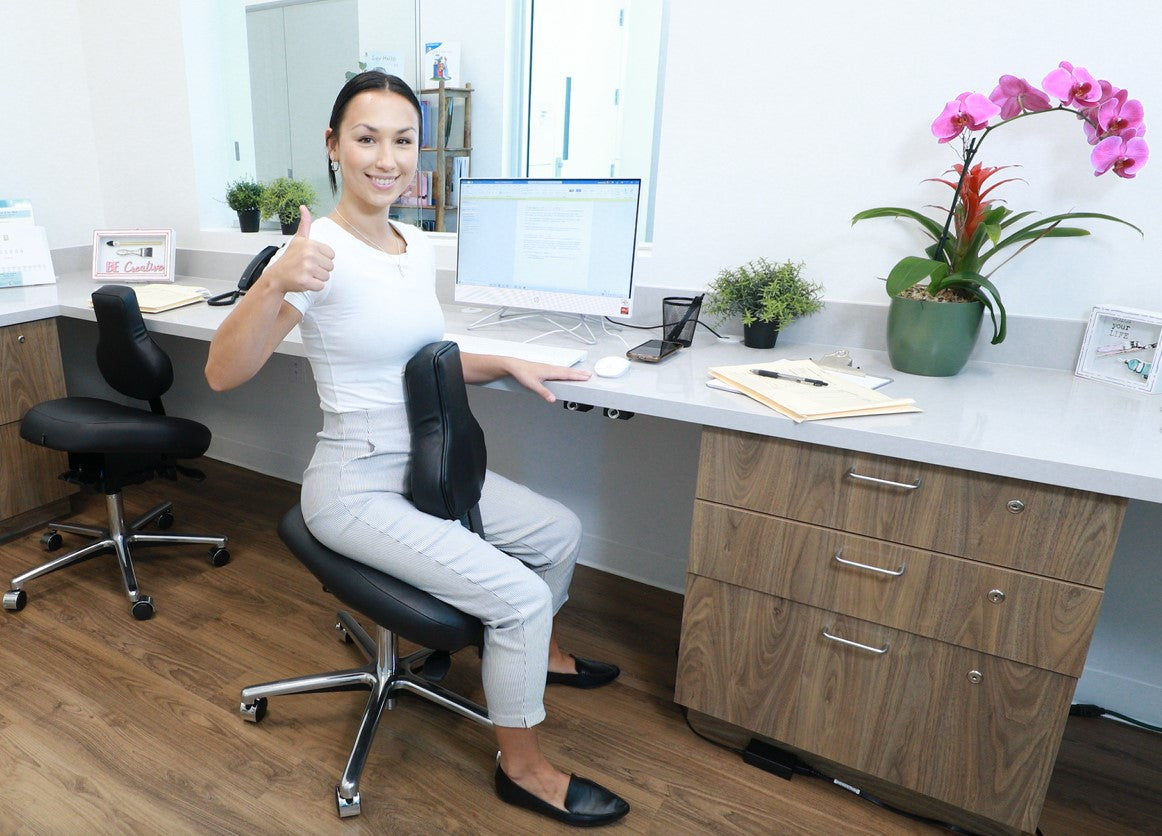
I’ve started using the NuChair as my dedicated scanning chair for patients receiving thermal imaging. For those scans, posture has to be upright, relaxed, and repeatable.
A traditional office chair introduces too much variability. Patients lean back differently. They slump. They fidget. With the NuChair, they naturally settle into a tall, stacked position.
The scans are more consistent. The data is cleaner. When something improves reliability in a clinical setting, it earns credibility quickly.
Professionally, this chair could make sense for orthodontists and periodontists. They lean forward for hours, focused on millimeters.
Dentists, hygienists, estheticians, nail techs, and tattoo artists, live in that forward zone. Even desk workers who start the day sitting back eventually find themselves perched at the edge of their seat, pulled toward the screen by concentration.
The NuChair simply formalizes that engaged posture and supports it correctly.
Here’s what most people notice in the first few days: You do not sit in this chair for eight hours on day one and forget about it.
There is an adjustment period. You will experiment with the angle, height, and front support. And your back muscles may fatigue at first.
That is not a flaw. It is feedback.
If your stabilizing muscles have been underused for years, waking them up feels unfamiliar.
When I began using the NuChair, I noticed that engagement almost immediately. After 20 minutes, I could feel muscles working differently. It took about three days before everything settled in and felt natural.
After that, upright sitting no longer felt like effort. It felt like default.
That early fatigue was reassuring. It signaled active support rather than passive bracing.
The aim of this chair is to encourage better neuromuscular patterns over time.
Subtle repetition. Daily reinforcement. Small corrections that accumulate.
The build quality reflects that seriousness. The frame feels stable. The mechanisms move smoothly. The seat structure prevents forward drift so you are not constantly compensating with your legs.
It does not feel like a gimmick or a posture experiment. It feels intentional.
Compared with traditional ergonomic chairs that emphasize plush cushioning and recline mechanics, the difference is philosophical.
Those chairs excel when you lean back. The NuChair excels when you lean in.
If you are someone who values lounge-like softness, this may not be your chair. If you are unwilling to go through a short adaptation window, it may feel demanding.
But if you care about how you sit during the hours that shape your body, this chair changes the environment in a meaningful way.
Posture is not about willpower. It is about systems. When the system changes, behavior follows.
NuChair alters the geometry of sitting so that upright becomes easier.
For forward-focused professionals and even for patients in my office, that geometry makes a difference.
And sometimes the most persuasive shift is not a lecture or a reminder to sit up straight. It is a chair that quietly makes the right position feel natural.
You can remind yourself to sit up straight a hundred times a day. Or you can change the environment once. I prefer the second approach.
Disclosure: The company provided this chair for evaluation. I was not paid for this review.


 A Chiropractor's Opinion